
Albert Einstein: Creativity से Genius बनने की कहानी
Albert Einstein: Creativity Se Genius Banne Ki Kahani
Albert Einstein is often remembered as the man with wild hair, deep eyes, and a chalkboard full of mysterious equations. For many people, he represents the highest level of intelligence a human being can reach. But the real story of Albert Einstein is not just about genius—it is about creativity, curiosity, freedom of thought, and the human right to think differently.
Einstein was not born a genius in the traditional sense. He was not a child prodigy who shocked the world with early achievements. Instead, he was a slow learner in the eyes of society, a rebel in classrooms, and a dreamer who believed imagination was more powerful than knowledge. His journey from an ordinary child to an extraordinary mind shows us that genius is not a gift—it is a process.
This is the story of how creativity turned a curious boy into one of the greatest minds in human history.
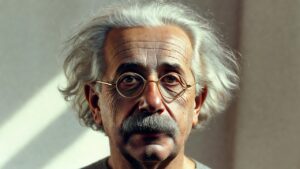 A Child Who Didn’t Fit the System
Albert Einstein was born on 14 March 1879 in Ulm, Germany. His family was middle-class, and his parents were kind, supportive people. However, young Albert was not like other children. He spoke late, often thinking silently before saying anything. Many adults worried that something was wrong with him.
In school, Einstein struggled—not because he was unintelligent, but because the education system demanded obedience, memorization, and discipline. Albert hated rote learning. He did not like answering questions without understanding them. He wanted to know why, not just what.
Teachers labeled him as lazy, slow, and difficult. One teacher even told him that he would never succeed in life. But what the system failed to see was that Albert’s mind worked differently. He was not designed to repeat answers—he was designed to create new questions.
This part of Einstein’s life reminds us of an important human truth:
Every child has the right to learn in their own way.
The Power of Curiosity and Imagination
One small event changed Einstein’s life forever. When he was around five years old, his father showed him a compass. Albert was fascinated by how the needle always pointed in one direction, even though there was nothing visible pushing it.
This simple object filled his mind with wonder. He began to think about invisible forces, hidden laws of nature, and mysteries beyond what the eyes could see. That curiosity never left him.
Einstein later said:
“Imagination is more important than knowledge.”
For him, creativity was not about art alone—it was about thinking freely, imagining possibilities, and exploring ideas without fear. While other students memorized textbooks, Albert imagined riding on a beam of light, asking himself what the universe would look like.
These thought experiments became the foundation of his greatest discoveries.
Failure Was Not the End—It Was the Beginning
Einstein’s academic journey was full of rejection. He failed the entrance exam to the Zurich Polytechnic on his first attempt. Later, after graduating, he struggled to find a teaching job. Professors did not recommend him because he was seen as disrespectful to authority.
For years, Einstein worked as a patent clerk in Switzerland. Many would see this as failure. But Einstein saw it differently. The job gave him something priceless—time to think.
During breaks, he explored ideas about space, time, light, and energy. Without expensive laboratories or titles, he used only his mind. In 1905, while still working as a clerk, he published four groundbreaking papers that changed physics forever. This year is now called Einstein’s Miracle Year.
His story proves a powerful lesson:
Your position does not define your potential.
Creativity Se Revolution: Changing How We See the Universe
Einstein’s most famous contribution, the Theory of Relativity, changed the way humans understand space and time. Before Einstein, time was considered absolute—same for everyone, everywhere. Einstein showed that time is relative; it can move faster or slower depending on speed and gravity.
This idea was not just scientific—it was deeply creative. Einstein did not follow existing rules; he questioned them. He trusted his imagination even when the world doubted him.
Later, his work helped lead to technologies we use today, including GPS, satellites, nuclear energy, and modern physics. Yet Einstein remained humble. He never claimed to be smarter than others.
He once said:
“I have no special talent. I am only passionately curious.”
This humility is an essential part of true genius.
A Human Being Before a Scientist
Albert Einstein was not only a scientist; he was a deeply human individual. He spoke openly against war, racism, and injustice. As a Jew, he faced discrimination in Germany, especially during the rise of Nazi power. In 1933, he was forced to leave his homeland and move to the United States.
Einstein used his voice to support human rights, peace, and freedom of thought. He believed science should serve humanity, not destroy it. Although his work indirectly contributed to the atomic bomb, he later became a strong advocate for nuclear disarmament.
He believed that intelligence without compassion is dangerous. For Einstein, being human mattered more than being famous.
Creativity and Freedom: The Core of Genius
Einstein’s life teaches us that creativity grows where freedom exists. Freedom to ask questions. Freedom to fail. Freedom to imagine.
He did not become a genius by following the crowd. He became a genius by listening to his inner voice, trusting curiosity, and respecting the human right to think differently.
In today’s world, many children and adults feel pressured to fit into systems that value marks over meaning, speed over depth, and obedience over originality. Einstein’s story reminds us that every mind is unique.
Genius is not about IQ alone. It is about:
-
Curiosity over fear
-
Imagination over limitation
-
Humanity over ego
Lessons for Today’s Youth
Albert Einstein’s journey offers timeless lessons for students, creators, and dreamers:
-
You are not weak if you think differently
-
Failure is part of creativity, not the end of it
-
Imagination is a human right, not a luxury
-
Education should develop thinking, not fear
-
Being kind and curious matters more than being perfect
Einstein proves that the world needs thinkers who dare to question, creators who imagine better futures, and humans who value peace over power.