“APJ Abdul Kalam: मिसाइल मैन की लाइफ से सीखें”
APJ Abdul Kalam: Learning from the Life of the Missile Man
Dr. Avul Pakir Jainulabdeen Abdul Kalam, affectionately known as the “Missile Man of India” and the “People’s President,” remains one of the most inspiring figures in modern Indian history. His journey from a humble background in Rameswaram to becoming India’s 11th President is a testament to the power of dreams, dedication, and unwavering determination. His life offers invaluable lessons that transcend boundaries of nationality, profession, and age, making him a universal icon of hope and excellence.
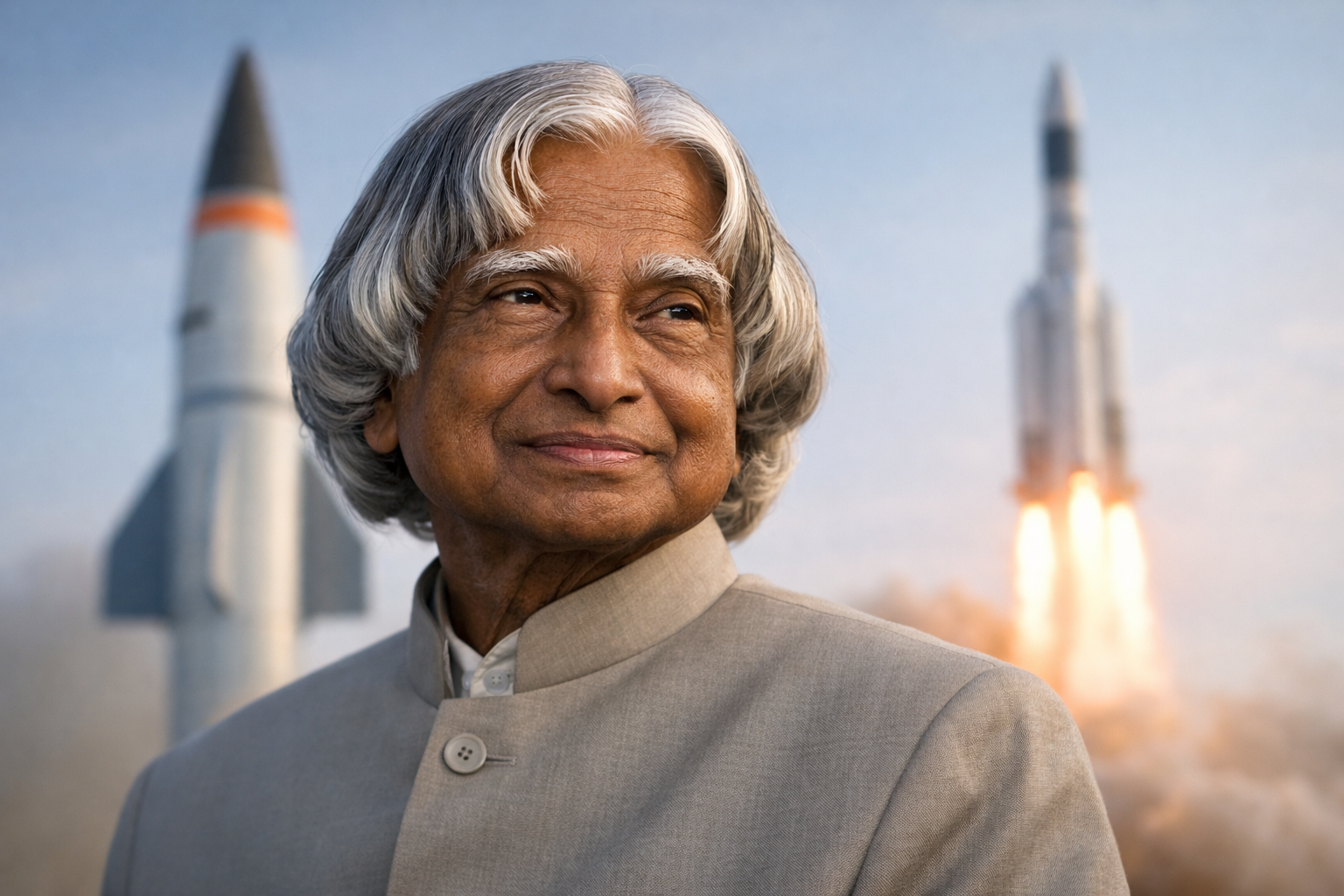
The Humble Beginnings
“APJ Abdul Kalam: मिसाइल मैन की लाइफ से सीखें”
Born on October 15, 1931, in the island town of Rameswaram in Tamil Nadu, Abdul Kalam came from a modest family. His father, Jainulabdeen, was a boat owner and imam of a local mosque, while his mother, Ashiamma, was a housewife. The family had limited means, and young Kalam had to sell newspapers to supplement the family income. Despite these financial constraints, his childhood was rich in values, discipline, and spiritual grounding.
Rameswaram, with its multicultural and multireligious environment, played a crucial role in shaping Kalam’s worldview. He grew up witnessing harmony among people of different faiths, an experience that would later influence his philosophy of inclusiveness and unity. His father’s simple lifestyle and his mother’s kindness left an indelible mark on his character, teaching him the importance of humility and compassion.
The first lesson we learn from Kalam’s early life is that circumstances of birth do not determine one’s destiny. Poverty can be a challenge, but it need not be a barrier to achievement. What matters is the fire within, the desire to learn, and the willingness to work hard.
The Passion for Learning
Despite the family’s financial difficulties, Kalam’s parents prioritized education. He attended Schwartz Higher Secondary School in Ramanathapuram and later pursued physics at Saint Joseph’s College, Tiruchirappalli, graduating in 1954. However, his true calling lay in aerospace engineering. In 1955, he moved to Madras (now Chennai) to study aerospace engineering at the Madras Institute of Technology (MIT).
At MIT, Kalam’s dedication was legendary. He would spend countless hours in the library and laboratory, driven by an insatiable curiosity about flight and aircraft design. One incident from his college days particularly stands out: his project guide gave him a month to complete a design project. When Kalam realized he wouldn’t meet the deadline with just three days remaining, his professor gave him an ultimatum—either complete it within the deadline or leave the institution. Kalam worked tirelessly for 72 hours straight and presented the project on time, demonstrating his commitment to excellence and deadlines.
This episode teaches us the importance of time management, accountability, and the ability to perform under pressure. Kalam learned early that deadlines are not mere suggestions but commitments that demand respect and fulfillment.
The Making of the Missile Man
After completing his education, Kalam joined the Aeronautical Development Establishment of the Defence Research and Development Organisation (DRDO) as a scientist in 1960. He began his career by designing a small hovercraft, but his ambitions soared higher. In 1969, he was transferred to the Indian Space Research Organisation (ISRO), where he served as the project director of India’s first Satellite Launch Vehicle (SLV-III), which successfully deployed the Rohini satellite in near-earth orbit in July 1980.
This achievement marked India’s entry into the space club, but it was just the beginning of Kalam’s contributions to the nation’s defense and space capabilities. He returned to DRDO in 1982 and conceived the Integrated Guided Missile Development Programme (IGMDP), serving as its chief executive. Under his leadership, India developed indigenous missiles including Agni and Prithvi, which significantly bolstered the country’s defense capabilities.
His work on these projects earned him the title “Missile Man of India.” However, what distinguished Kalam was not just his technical brilliance but his leadership style. He believed in empowering young scientists, creating an environment where innovation could flourish, and maintaining an optimistic outlook even in the face of failures.
The SLV-III project, for instance, faced a significant setback when its first launch failed in 1979. While the ISRO chairman took responsibility for the failure in the press conference, when the project succeeded a year later, he ensured that Kalam stood at the forefront to receive the accolades. This experience taught Kalam an invaluable lesson about leadership—true leaders take responsibility for failures and share credit for successes.
Vision 2020 and Nation Building
“APJ Abdul Kalam: मिसाइल मैन की लाइफ से सीखें”
In 1998, Kalam, along with Y. S. Rajan, wrote “India 2020: A Vision for the New Millennium,” outlining an action plan for developing India into a knowledge superpower and a developed nation by 2020. The book identified five areas where India had core competencies: agriculture, education and healthcare, information and communication technology, infrastructure, and self-reliance in critical technologies.
This vision was not merely theoretical but reflected Kalam’s deep understanding of India’s potential and the roadmap needed to realize it. He traveled extensively across the country, especially to educational institutions, spreading this message of hope and possibility. He firmly believed that India’s youth held the key to the nation’s transformation.
His emphasis on education, particularly scientific education, stemmed from his conviction that knowledge is the primary resource for development in the 21st century. He advocated for a education system that fostered creativity, critical thinking, and moral values alongside technical knowledge.
The lesson here is the importance of vision and long-term thinking. Kalam demonstrated that progress requires not just hard work in the present but a clear understanding of where we want to be in the future and a concrete plan to get there.
The People’s President
In 2002, Dr. Kalam was elected as the 11th President of India, serving until 2007. His presidency was marked by his accessibility and connection with common people, especially students. He was often called the “People’s President” because he opened the doors of the Rashtrapati Bhavan to citizens from all walks of life.
During his tenure, he continued his mission of inspiring youth. He visited schools, colleges, and universities across India, interacting with students, answering their questions, and encouraging them to dream big. His famous quote, “Dream is not that which you see while sleeping, it is something that does not let you sleep,” encapsulates his philosophy of passionate pursuit of goals.
Kalam’s presidency also demonstrated that high office need not change one’s essential character. He remained humble, accessible, and committed to service. He lived simply, continued to be a vegetarian, and maintained his routine of prayer and meditation. He showed that power is a responsibility, not a privilege, and that leadership is about serving others, not being served.
Philosophy and Values
Throughout his life, Kalam emphasized certain core values that guided his actions and decisions. These values form the foundation of the lessons we can learn from his life:
Integrity and Honesty: Kalam believed that integrity is non-negotiable. In both personal and professional life, he maintained the highest ethical standards. He once said, “For great men, religion is a way of making friends; small people make religion a fighting tool.”
Hard Work and Perseverance: His life exemplified that there are no shortcuts to success. Every achievement was the result of countless hours of dedicated effort. He would often work 18-hour days, driven not by ambition for personal glory but by commitment to his goals.
Continuous Learning: Even as President, Kalam remained a student at heart. He read voraciously, stayed updated with scientific developments, and was always eager to learn new things. He believed that learning is a lifelong journey.
Humility: Despite his monumental achievements, Kalam remained remarkably humble. He never allowed success to inflate his ego or distance him from common people. He treated everyone with respect, regardless of their position or status.
Spirituality and Universal Values: Kalam was deeply spiritual and drew strength from multiple religious traditions. He often quoted the Bhagavad Gita, the Quran, and the Bible, emphasizing the universal values that unite all religions. His spirituality was inclusive and focused on the divine in all creation.
Inspiring the Youth
If there was one mission that defined Kalam’s post-presidential years, it was inspiring India’s youth. He believed that young people had the potential to transform India and dedicated his remaining years to igniting their minds. He delivered thousands of lectures at educational institutions, wrote books aimed at young readers, and engaged with students through various platforms.
His message to youth was consistent: dream big, work hard, stay committed to your values, and serve the nation. He encouraged students to pursue careers in science and technology, not merely for personal success but to contribute to solving India’s challenges in agriculture, water management, healthcare, and infrastructure.
Kalam’s ability to connect with young people was extraordinary. Despite being a renowned scientist and former President, he spoke to students in simple language, shared personal anecdotes, and made complex concepts accessible. He answered every question with patience and encouraged students to think independently and question conventional wisdom.
The Final Lesson
On July 27, 2015, Dr. Kalam was delivering a lecture at the Indian Institute of Management Shillong when he collapsed and passed away. True to his character, he died doing what he loved most—teaching and inspiring young minds. His death while engaged in his life’s mission was, in a poetic way, the perfect culmination of a life lived with purpose and dedication.
His passing was mourned across India and the world. People from all backgrounds came to pay their respects, testament to the universal appeal of his life and message. The enormous public response to his death showed that he had touched millions of lives and that his legacy would endure.
Lessons for Today and Tomorrow
Dr. APJ Abdul Kalam’s life offers numerous lessons that remain relevant in today’s world:
Dream Without Limits: Kalam showed that our dreams should not be constrained by our current circumstances. A boy from a small town with limited resources dared to dream of flying and reached for the stars.
Education is Liberation: Education was Kalam’s pathway to transformation, and he believed it could be the same for every Indian child. Investing in education, especially in science and technology, is investing in the future.
Failure is Not Final: Kalam experienced failures, from the initial SLV-III launch failure to various setbacks in missile development. However, he viewed failure as a stepping stone to success, an opportunity to learn and improve.
Leadership is Service: True leadership is about empowering others, taking responsibility, and working for the greater good rather than personal gain. Kalam’s leadership style was collaborative, inclusive, and always focused on the team’s success.
Stay Grounded: No matter how high we rise, maintaining humility and connection with our roots is essential. Kalam never forgot his origins or the values his parents instilled in him.
Unity in Diversity: Growing up in a multicultural environment, Kalam understood that India’s diversity is its strength. He championed harmony among communities and believed that progress requires collective effort.
Give Back: Kalam’s entire post-retirement life was dedicated to giving back to society, especially to young people. Success is incomplete if not shared with others.