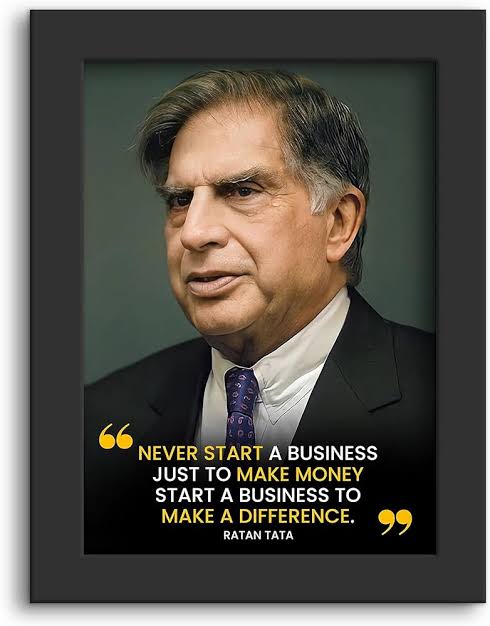
Ratan Tata: Humanity, Business & Leadership – A Story Beyond Success
Ratan Tata: Humanity, Business & Leadership – A Story Beyond Success
In the modern world, where business is often measured only by profits, market share, and valuations, Ratan Naval Tata stands as a rare and inspiring exception. He is not just a successful industrialist; he is a symbol of humanity, ethics, simplicity, and visionary leadership. His life proves that true success is not about how much money you make, but how many lives you touch and uplift.
Ratan Tata’s story is not a fairy tale of instant success. It is a journey filled with loneliness, criticism, risk, courage, failures, and silent victories. Through his calm personality and strong moral compass, he transformed the Tata Group into a global powerhouse while never losing sight of human values.
This is the story of Ratan Tata: a leader who chose compassion over ego, nation-building over personal wealth, and humanity over fame.
 Early Life: A Childhood Shaped by Simplicity and Struggles
Ratan Tata was born on 28 December 1937 in Bombay (now Mumbai) into the prestigious Tata family. While many assume he grew up surrounded by luxury, the reality was far more complex. His parents separated when he was very young, and he was raised by his grandmother, Lady Navajbai Tata, a woman of strong values and discipline.
This early emotional distance shaped Ratan Tata’s personality. He grew up introverted, sensitive, and deeply observant. Unlike many children from elite families, he learned the importance of humility, patience, and self-reliance at a young age.
He completed his schooling at Campion School and Cathedral and John Connon School, later moving to the United States to study architecture at Cornell University. Later, he attended the Harvard Business School, where he gained exposure to modern management practices.
Despite his privileged background, Ratan Tata never believed in entitlement. He believed that respect must be earned, not inherited.
Starting from the Bottom: A Leader Who Learned on the Shop Floor
When Ratan Tata joined the Tata Group in 1962, he did not enter as a chairman or executive. Instead, he chose to work on the factory floor of Tata Steel, shoveling limestone and handling heavy equipment.
This decision shocked many, but it revealed his leadership philosophy:
“To lead people, you must first understand their work and struggles.”
He spent years learning different businesses within the Tata Group, observing employees, understanding systems, and quietly preparing himself. These experiences grounded him in reality and gave him deep empathy for workers.
Becoming Chairman: A Storm of Resistance
In 1991, Ratan Tata became the Chairman of Tata Sons. His appointment was met with intense resistance from senior executives who doubted his leadership and vision. Many believed he was too soft-spoken, too reserved, and inexperienced.
But Ratan Tata believed in long-term vision over short-term approval.
At that time, the Tata Group was a loose collection of independent companies with little unity. Ratan Tata initiated bold reforms:
-
Introduced retirement age limits for senior executives
-
Brought in young leadership
-
Focused on innovation and global expansion
-
Strengthened corporate governance
These decisions were unpopular, but necessary. Over time, they laid the foundation for a stronger and more unified Tata Group.
Global Vision: Taking India to the World
One of Ratan Tata’s greatest contributions was transforming Tata into a global brand.
Under his leadership, Tata acquired iconic international companies:
-
Tetley Tea (UK)
-
Corus Steel (UK)
-
Jaguar Land Rover (JLR) (UK)
The acquisition of JLR was widely criticized at first. Many experts predicted failure. But Ratan Tata trusted his instincts and believed in Indian capabilities. Today, JLR is one of Tata Group’s most successful ventures.
These achievements were not just business victories; they were moments of national pride. Ratan Tata proved that Indian companies could compete and succeed on the global stage.
The Tata Nano: A Dream for the Common Man
Perhaps the most emotional chapter of Ratan Tata’s life was the creation of the Tata Nano, the world’s cheapest car.
The idea was born when he saw a family of four riding a scooter in the rain. He wanted to provide a safe, affordable car for Indian families.
The Nano faced production challenges, protests, and commercial failure. From a business perspective, it did not succeed. But from a human perspective, it was a revolutionary idea.
Ratan Tata later said:
“I don’t consider the Nano a failure. It was an honest attempt to solve a real problem.”
This mindset defines him: failure is acceptable, but lack of intention is not.
Humanity First: Compassion Beyond Boardrooms
Ratan Tata is known for his quiet philanthropy. He rarely speaks about his charitable work, but his actions speak louder than words.
Through Tata Trusts, nearly 66% of Tata Sons’ profits are used for social causes, including:
-
Education
-
Healthcare
-
Rural development
-
Clean water
-
Scientific research
He personally supports:
-
Young entrepreneurs
-
Startups with social impact
-
Students from underprivileged backgrounds
-
Animal welfare causes
One of the most touching aspects of his personality is his love for animals, especially dogs. He has ensured that stray dogs are cared for at Tata offices, showing that compassion extends to all living beings.
Leadership Style: Silent Strength and Moral Courage
Ratan Tata’s leadership style is unique:
-
He listens more than he speaks
-
He avoids unnecessary publicity
-
He believes in ethics over shortcuts
-
He values people more than power
He never chased personal wealth. Even today, he lives a simple and disciplined life, without extravagance.
His leadership teaches us:
-
True leaders empower others
-
Humility is a strength, not a weakness
-
Integrity builds lasting success
-
Purpose is greater than profit
Awards and Recognition: Respect Earned, Not Demanded
Ratan Tata has received numerous national and international honors, including:
-
Padma Bhushan (2000)
-
Padma Vibhushan (2008)
-
Honorary doctorates from leading universities
Yet, he remains grounded. He often says that the greatest reward is trust and respect from people.
Lessons from Ratan Tata’s Life
Ratan Tata’s life offers powerful lessons for students, entrepreneurs, and leaders:
-
Lead with values, not ego
-
Take risks for the greater good
-
Accept failure with dignity
-
Success means service
-
Kindness is the highest form of leadership